Britain’s duff leadership culture

By Martin Vogel

The challenge of bringing fresh and adaptive leadership in a complex and volatile world is a global problem. But an insightful analysis by The Economist highlights distinctly British dimensions:

“Britain’s leadership crisis is rooted in the evolution of the old establishment into a new political class. This evolution has been widely hailed as a triumph of meritocracy over privilege, and professionalism over amateurism. In fact, the new political class has preserved many of the failures of the old establishment. It is introverted and self-regarding, sending its members straight from university to jobs in the Westminster village, where they marry others of their kind. It relies on bluff rather than expertise, selecting those trained in blaggers’ subjects like PPE and slippery professions like public relations and journalism (Mr Cameron worked in PR before going into politics, whereas Mr Gove and Mr Johnson, along with his brother, another Tory MP, were hacks).
“At the same time, the political class has abandoned one of the virtues of the old establishment. The old ruling class preserved a degree of gentlemanly self-restraint. Senior politicians left office to cultivate their gardens and open village fetes. The new political class, by contrast, is devoid of self-restraint, precisely because it thinks it owes its position to personal merit rather than the luck of birth. Thus meritocracy morphs into crony capitalism. Tony Blair has amassed a fortune since leaving office and George Osborne, Mr Cameron’s former chancellor of the exchequer, is following eagerly in his footsteps.”

The attitude described here infects leadership well beyond the sphere of politics. The Financial Times has described the rewards extracted by the top brass of the Crossrail project – where private sector executives have used a governance structure designed to limit political meddling to extract handsome rewards, despite failing to deliver the project this year as promised:

“The deal gave Crossrail’s bosses great freedom so long as they lived within their budget. They took full advantage, paying themselves handsomely. When (departing chief executive) Mr Wolstenholme left this year, he received £765,689, including a £160,000 bonus, and £97,000 for ‘loss of employment’, despite numerous signs that the project was unravelling. The previous year, he banked £950,000, including a £481,460 bonus.”

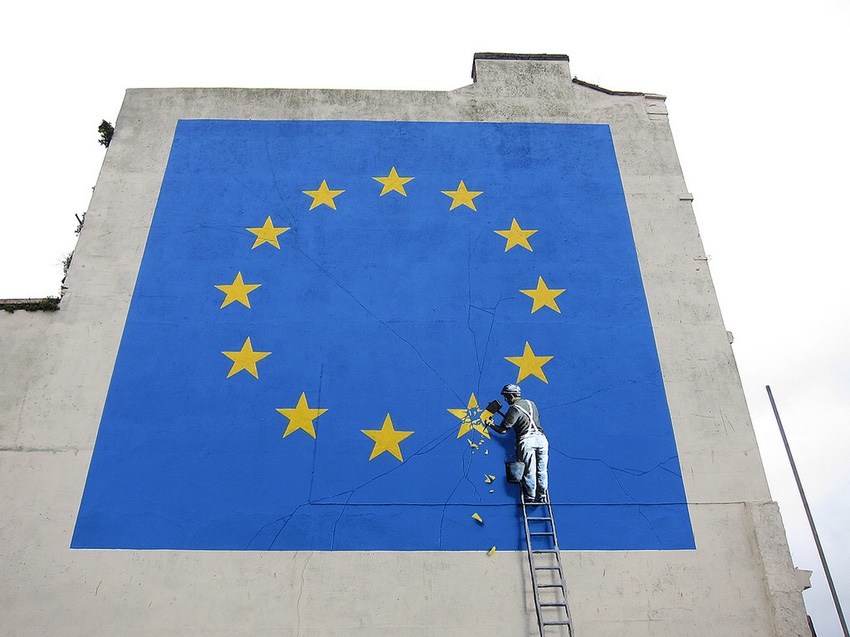
Duff leadership is a problem not just because it has adverse impacts on the issues it is trying to manage. The self-aggrandisement of the chumocracy combined with its ineptitude undermines people’s belief in change and thus their motivation to engage. Perhaps this accounts for the strange inertia as the country heads towards the possibility of a car-crash Brexit. We need a revolution of distributed leadership. Looking to the elite to empower activists is a waste of time. People of initiative need to come together in self-organising common cause to brush aside the narcissists whose reign has failed.

Image courtesy Miguel Bruna.

We’re better than this

By Martin Vogel

So the Government’s plans for the end of free movement are revealed. Sajid Javid speaks of Britain being open for business. But, in an angry thread on Twitter, Ian Dunt nails the true significance of the measure:

And of Labour’s complicity with Government policy, he says:

I find the anti-immigrant sentiment depressing, the more so when dressed up in liberal rhetoric. Britain doesn’t have to be this way. There’s a positive story of our experience of immigration. If politicians won’t speak up for it, we still have The Proclaimers. https://www.youtube.com/watch?v=y67ZTTRzqVk

Tracking down Conquest’s law on organisations

By Martin Vogel

The more it is cited, the more frustrated I become about “Robert Conquest’s Third Law of Politics” which is said to state:

The simplest way to explain the behaviour of any bureaucratic organisation is to assume that it is controlled by a cabal of its enemies.

The aphorism strikes me as so profound and relevant that I have often tried to verify its attribution. Conquest was a renowned historian of the Soviet Union, so his opinions on the politics of organisations carry considerable credibility.

Read More »

The leaders we create

By Martin Vogel

It’s a cliché of politics to say that we get the leaders we deserve. If that’s true, it begs the question: what have we done to deserve the myopic and divisive leadership that has taken us to the precipice of chaos? A clutch of articles looking at Britain from the outside provide some answers. The Economist considers how Britain’s European allies are looking on with bemusement at its collective nervous breakdown. For them, it’s not just that they are losing a close partner but also grieving the loss of an idea of what Britain represents. No longer sensible and reliable but a country revealed to be as chaotic and headstrong as any other:

“The biggest worry is not that the world’s view of Britain is changing. It is that this darker view of Britain is more realistic than the previous one. The Brexit vote could almost have been designed to reveal long-festering problems with the country: an elite educational system that puts too much emphasis on confidence and bluff and not enough on expertise; a political system that selects its leaders from a self-involved Oxbridge clique; a London-focused society that habitually ignores the worries of the vast mass of British people; and a Conservative Party that promotes so many pompous mediocrities. The reason Brexit is doing so much damage is not just that it is a mistake. It is a reckoning.”


Read More »

A moderate proposal

By Martin Vogel

Matthew Parris is worried that the UK is heading for a no-deal Brexit because the moderate majority in Parliament doesn’t know how to face down the Brexit extremists (£). A former MP himself, he thinks it imperative that scared centrists among the Conservatives and Labour find a way to break ranks with tribal party loyalties to make common cause. He has a proposal that would both break the stalemate and allow Theresa May to relinquish her loathed deal with good grace:

“Don’t whip the vote. Declare this decision to be so important, so epoch-making, that only a free vote by MPs could honestly legitimise it. The public will like the sound of this, and there’s a chance Labour might be embarrassed into lifting their whip too. The government is still likely to lose but the defeat then would be far from a ‘confidence’ issue. For May, the can is kicked a little further down the road, which seems anyway to be as far as she wants to lift her eyes.”

The appeal of this proposal is not only that it might create new momentum in the Brexit process but also that it could create a new dynamic in the wider political culture:

“When Remainer Tories walk through the voting lobbies alongside Labour MPs they’ll see opponents who have become co-campaigners, kindred spirits, perhaps even friends. Who can say what might result, but I think that in purely human terms, something might shift within that ghastly Victorian prison they call Westminster. As MPs shuffle past the tellers together, momentarily unattached from party, and in a flurry of shared glances, something might be born.”

I think this is the most likely way that we will eventually overcome polarised politics. For all the talk of a new party, the hunger for new ideas, and the waiting for a political saviour, the most plausible impetus for change will be when people of shared values link hands across traditional divides and begin exploring the possibilities that emerge.

Image courtesy Sandra Ahn Mode.

Generating expansive conversations with open space

By Martin Vogel

As previously discussed on this blog, we favour conversational approaches to eliciting the development of leaders. When we’re working with groups who have an ambitious purpose but face a variety of complex options, we look for ways to break free of linear and binary thinking and instead synthesise diverse perpectives.

One approach on which we draw for inspiration is open space. It seems a pre-requisite for these conversational processes that they have mystifying names. This is no exception and its formal nomenclature – given by its originator, Harrison Owen – is Open Space Technology. Beneath the name lies gold. Put simply, it is a method for a group of people to self-organise multiple, simultaneous conversations around a related theme. It is energising for the participants and, in our experience, produces more interesting outcomes than laboured discussions led by facilitators.

Read More »

Beyond codes of ethics to ethical maturity

By Martin Vogel

A recent article by Kara Swisher in the New York Times appeared under the headline Who Will Teach Silicon Valley to Be Ethical? Tech companies have been attracting a fair amount of criticism this year over their grasp of ethics. But they’re not alone in finding this area a minefield. The shareholder value view of firms, which has it that their sole purpose is to make a profit, still shapes leadership thinking in most organisations. This infects even those – like the BBC or NHS – that aren’t ostensibly profit focussed but where stripping out cost often crowds out other considerations. Where a reductionist view of purpose prevails, it’s not surprising that questions of ethics may receive scant consideration.

Kara Swisher considers various solutions including companies appointing chief ethics officers, putting in place official systems of ethics or (radical idea) chief executives stepping up to the plate to provide more leadership. She quotes an unnamed ethical consultant who complains that appointing custodians of ethics would be no more than window dressing because “we haven’t even defined ethics yet”.

Running through all of this is an assumption that ethics can be defined to delineate universal principles that clearly determine ethical or unethical behaviour in all eventualities. Coaching has been pursuing this track for some years. Every professional association of coaches has a code of ethics that its members commit to follow. And yet coaches, who are privy to ethical dilemmas more than most in business, must know that ethical choices are highly contingent on the contexts in which they arise. This is the essence of the well-known trolley problem: it’s obviously wrong to kill someone; but what if doing so saves the lives of five others? Read More »

England’s shame

By Martin Vogel

If you do one thing today, find a way to read Daniel Finkelstein’s column in The Times (alas behind a paywall) explaining why Britain seems to be heading inexorably to a no-deal exit from the EU:

“There is a widespread view that the chance of having no deal is pretty low because such an outcome would be calamitous and, anyway, there is no majority for it. It’s surely too stupid a thing to allow actually to happen? That view is wrong. It is incredibly complacent. Mrs May has returned with the only deal we are going to be offered and parliament won’t pass it. This by itself means that the chances of no deal are very high indeed. Looked at another way, the things we have to do now to secure a deal are looking forbiddingly difficult.”

Incredibly, there are MPs who – even now – do not grasp that no deal means no transition agreement. Britain would crash out of the EU wholly unprepared. And, as The Times revealed last month, the Government’s contingency plans for this – such as they are – include troops on the streets (£) to keep public order.

We have a Government and Parliament that for nearly three years has been leading the UK to a destiny they find contrary to the national interest. Conflicted between the mandate of the referendum and the mandate of representative democracy, they have left it much too late to find a responsible strategy. If Daniel Finkelstein proves right, they will have capitulated to chaos.

No wonder he concludes his piece, “What a disaster. What a disgrace.”

Image courtesy Duncan Hull.

Why write?

By Martin Vogel

What’s the point of writing? Amid the torrent of tweets, snaps and status updates, the verbiage of fake news and the dreck of junk mail, why would we need more words in the world? And yet we do. We constantly need to write the world afresh. For all that some authors, such as Jane Austin, endure, mostly the great writing names of an age fade away. Who now reads Graham Greene or Kingsley Amis? Even Martin Amis? The Neapolitan Novels are today’s Dance to the Music of Time.

Writing is an act of engagement with our world in the here and now. Note, this is so even of historical fiction or sci fi: it normally reflects contemporary concerns. How could it not do since it is shaped much more by the filters and perceptions of the age and culture in which it is formed not that which it is about? But writing need not necessarily be a public act. Writing as engagement with the world is an act we can all get in on.

Read More »

Taking the pulse of an organisation

By Martin Vogel

If there’s one signature intervention that characterises how we work at Vogel Wakefield, it is the diagnostic enquiry into what’s going on in an organisation. This draws on skills developed over the course of our careers in journalism, strategy and coaching – and, in my case, my epistemological formation as a sociologist. Put simply, it entails getting lots of people to talk to us about their working lives. And trying to understand what it is they need to talk about together that they’re not discussing. Many of our engagements begin this way – particularly when a team or organisation is stuck in some way, which is usually when they turn to consultants.

Read More »

Shaping disaffection is the way to mend broken politics

By Martin Vogel

Kenan Malik has an insightful critique of the failure of moderate politicians to provide an answer to populism:

“It’s not populist disaffection that is unreasonable, but the policies and institutions that have created that disaffection. Policies that have driven up inequality and driven down living standards. Institutions that have excluded people from the process of decision-making. There has been much talk of ‘out of touch’ politicians. Little expresses that out-of-touchness more than the fact that for almost a decade politicians have spent more energy worrying about populism than about the policies that have nurtured disaffection.”

That there is widespread demand for politics that addresses the disaffection is underlined by a YouGov opinion poll in The Sunday Times which suggests that nearly half of people think politics is broken. Only one in seven think the Conservatives and Labour represent the views of the public. Two thoughtful pieces during the year gave shape to the kind of thinking that could rejuvenate the two main parties.

Read More »

Messages from history for Brexit Britain

By Martin Vogel

What are we to make of the chaos and uncertainty facing Britain this weekend as Parliament prepares to approve or vote down Theresa May’s deal on Brexit? Two contrasting views are on offer from writers who, curiously, both reference the Sex Pistols’ song God Save the Queen. Johnny Rotten’s punk anthem from the 1970s is a message from an era of division and chaos that ultimately led to the Winter of Discontent. Are we on the brink of returning to the abyss?

Read More »

Embrace boredom

By Martin Vogel

I’ve been re-engaging with deep work by listening to an old podcast by Cal Newport introducing his ideas on the subject.

In order to create more focus in one’s work, it’s not necessary to transform one’s life to achieve black belt status in the art of concentration. Adopting three simple maxims can shift the dial:

  • Plan each week to do just five hours of deep work
  • Embrace boredom
  • Eliminate unnecessary social media and news browsing

Actually, maxims two and three are variants of each other. Many of us convince ourselves that there is a productive justification for engaging in social media. But social media usage soon becomes a habit for filling ones idle moments with cognitive stimulation – that is to say, staving off boredom. Just look around you on any rush-hour train. Most people who are travelling alone will occupy the time staring at their phones. And a good many of those travelling with someone else will do so too.

I’m increasingly convinced that there isn’t enough boredom in life. Absence of stimulation has become an anxiety-provoking state: almost as if we have assume we have an existential right not to be bored.

Read More »

Nick Cave as coach

By Martin Vogel

Nick Cave has initiated an interesting project answering questions sent in from his fans. The questions are searching. The meditations Nick Cave composes in reply are works of artistry in their own right.

Last year, I wrote about the transcendent experience of the Nick Cave and the Bad Seeds concerts that followed the death of his son. The first of his epistles addresses this very theme. He describes how immersion in work and – in so doing – recovering a sense of wonder helped him find community and accept his grief:

“I kind of realised that work was the key to get back to my life, but I also realised that I was not alone in my grief and that many of you were, in one way or another, suffering your own sorrows, your own griefs. I felt this in our live performances. I felt very acutely that a sense of suffering was the connective tissue that held us all together.”

Read More »

Feedback without tears

By Martin Vogel

How to give feedback is an issue that comes up with increasing frequency in my coaching work. It reflects, I suspect, a normative advocacy of feedback cultures in organisations. This arouses considerable anxiety among people who feel themselves under pressure to provide feedback left, right and centre. They often hold a belief that, if only they could get the recipe right, they could learn how to transmit feedback and move on.

There are some well-meaning intentions behind feedback culture. In particular, it draws on Carol Dweck’s idea of a growth mindset – whereby people welcome corrective feedback as a platform for their development. But the espousal of feedback can also be oppressive because the linear and mechanistic assumptions around “delivering feedback” ignore the complex feelings it can arouse.

While models of providing feedback have their place, the problem with the “recipe” view of feedback is that it ignores how the “delivery” of feedback will be received by the other party. People are not automatons and the difficulty for people providing feedback is that they can really have no idea in advance how it will land. Simply understanding this can relieve some of the stress for those anticipating getting the feedback process wrong.

Read More »

From toolkits to relationships: getting real about what happens in coaching

By Martin Vogel

The practice of coaching has many antecedents. But one that most eased its way into the corporate world was the analogy between sports coaching and leadership development. Corporations are susceptible to narratives of being world class and winning. So learning from methodologies fine-tuned to get the best out of athletes can be appealing to the corporate leader’s world view. This, for a long while, created an emphasis in the development of coaches on the acquisition of skills and techniques. Coaches would turn up with their “toolkits” and fine tune their clients’ performance in the pursuit of specified goals.

The Theory and Practice of Relational Coaching by Simon Cavicchia and Maria Gilbert proposes a different perspective. It views coaching as a dialogue of discovery between coach and client, one which calls on the practitioner to cultivate awareness and empathic attunement more than it demands technical accomplishment. It’s an approach which is grounded in the insight that all of our experience is socially constructed. There is no fixed thing called an organisation which provides a predictable environment for our working lives. It is enacted every day by its participants and shaped by the different world views that each of them brings by virtue of their biography.

Read More »

The serious business of playing the Fool

By Martin Vogel

fool

It’s a shame that Hetty Einzig’s The Future of Coaching is so-called. Its concerns spread much wider than its title implies. It’s a radical and thoughtful book which holds before us the chaotic nuttiness of the world as it is now and asks what kind of leadership should coaching call forth.

Hetty Einzig takes it as axiomatic that the big challenges we humans face demand committed and creative interventions by leaders. Never mind present concerns such as Brexit or Trump, Hetty reminds us that the broader context is that of a trajectory to environmental catastrophe. She has no truck with the notion that coaches should be neutral facilitators of whatever goals their corporate clients might pursue. Nor does she believe leaders should collude with such ideas. Coaches and leaders alike are citizens in wider society as well as servants of the organisations that employ them. It is the legitimate task of all of us to try to influence organisations to play a constructive role in addressing society’s problems.

Read More »

The benefits of dual nationality

By Martin Vogel

Daniel Finkelstein writes in The Times about why he won’t be joining the rush for dual nationality (£) among those Britons who fear for their country’s future. Like me, he is the son of a refugee from the Nazis and perhaps this explains why he is able to define clearly, while not sharing them, the motivations of those – like me – who are exercising their right to another nationality:

“Their application is a sort of protest against Brexit and an insurance policy in case Brexit presages a less tolerant Britain or a calamitously poor one. And there are also some Jews who worry about a Corbyn government.”

He recalls in his childhood reading with his mother about the kings and queens of England:

“Only as an adult have I reflected that when the Tudor monarchs reigned, or even the Georgians, my family wasn’t here. We lived under distant emperors. But still, I reflect, we chose these great Britons and they chose us. Their countrymen gave us a home and our liberty and peace. And I’m never going to be part of something else.”

I can certainly relate to this sentiment. My father recalls his arrival at Dover in 1939 when he was eleven years old and had escaped with his parents from Czechoslovakia after it was occupied by the Nazis:

“There were no inquisitions into whether we had any rights to be entering Britain, or the type of unwelcoming unpleasantness present-day refugees and immigrants have to experience. There was no waiting about while officials decided whether we were to be allowed to enter the country. Quite simply: we were welcomed and that was that, and we were very, very grateful to be in England.”

That gratitude to the UK has stuck with him to this day and certainly informs my own attachment to this country.

Read More »

On bringing your whole self to work

By Martin Vogel

wholeperson

Pilita Clark seems to have taken up a role in the FT, previously occupied by Lucy Kellaway, debunking fashionable corporate nonsense. Her latest piece takes issue with the trend to encourage employees to “bring your whole self to work”:

“This fatuous phrase has blossomed into ever wider use in offices around the world, where it masterfully suggests a company … is so anxious to please its workers it is happy to have them behave at work as they would at home. This is patently untrue. Companies want workers who are industrious and easy to manage. Workers, for that matter, are generally looking for companionable, civil colleagues who get on with the job at hand.”

Part of the problem that Pilita identifies is that nobody really know what bringing your whole self to work means: it covers everything from sharing your personal life with colleagues to bringing your dog into work. If her interpretation is true, it suggests that the notion of bringing your whole self to work has become so devalued through overuse as to be worthless.

This would be a shame since it has honourable roots in the human potential movement.

Read More »