Searching for a silver lining

By Martin Vogel

Nobody likes cuts. But is it too outlandish to see an upside to financial uncertainty? Perhaps not. Organisations that navigate the storms ahead may gain more autonomy to set their own destiny. A possible outcome could be that they reconnect with their fundamental purpose and refresh how they deliver value to audiences.

This may sound panglossian. In austerity, our energies concentrate simply on survival and the niceties of maintaining and delivering a vision recede to the sidelines. But it can be a mistake to treat the values that inform an organisation as too costly a luxury to merit attention at a time like this. Clarity about what an organisation exists to achieve is central to making good decisions in the face of challenge.

Read More »

Mind the gap: how to focus on your purpose in the arts

By Martin Vogel

gallery
Empty gallery.

A theatre won funding to improve its engagement with disadvantaged groups. It approached the challenge as the chance to spread the word about its work. But it discovered that to get the target groups through the doors, the work would need to change. What the theatre was doing from day to day turned out to be irrelevant to a section of the community it was meant to serve. This is an example of the gap that can occur between the way an organisation behaves compared to its avowed mission, one that provides the sense of purpose from a shared understanding among everyone who works in a company.

Read More »

David Cameron and Nick Clegg: The Odd Couple

By Martin Vogel

First taste of power

When Barack Obama took office as President of the United States, I was struck by his effort to accommodate rivals within his cabinet. Now we have our own cabinet of rivals governing the United Kingdom and the impact on the tone of our politics has been immediate.

There are warnings in the press that the unlikely pact between the Liberal Democrats and the Conservatives will end in tears. All governments end in failure at some point. But for now, we have a more adult-to-adult and consensual political discourse and the signs are that the leaders will try their utmost to make it stick.

Read More »

Leadership and the Election: Gordon Brown

By Martin Vogel

Gordon Brown at the G8

By Martin Vogel

I hesitate to blog about politics, but am inspired to reflect on a post at the Coaching Commons blog about Gordon Brown’s handling of the post-election situation.

My initial response to the post, written by a US observer, was to notice the folly of making coaching judgments about foreign cultures. The premise of the piece was a misreading of the British constitution, that Brown was clinging to office. As evidence, it offered, without scepticism, opinion drawn from Britain’s famously partisan press. Clinging to office Brown may have been. But he was also prisoner of the vacuum at the heart of power, unable to leave until it was clear a new government could take Labour’s place. As it turned out, the premise was undermined almost as soon as the piece was published, with Brown announcing his intention to resign so as not to stand in the way of any possible deal between his party and the Liberal Democrats.

Read More »

The science of valuing chaos in organisations

By Martin Vogel

A fractal

Book review: Leadership and the New Science by Margaret Wheatley

Between the mysterious, almost inconceivable science of quantum physics and the mundane experience of working in a large organisation it would be hard to think of realms that are further apart. So Leadership and the New Science, by Margaret Wheatley, which seeks to apply insights derived from contemporary science to organisational life, is a book I approached with some scepticism. What possible relevance to the world of work could be found in the fundamental science of how matter functions below the level of the atom or how everything in the universe is inter-connected? These seem such big and incomprehensible questions that daily life is able to get along just fine without reference to them.

Reading the book, though, I soon realised that it was precisely because my thinking was shaped by the insights of traditional science that I couldn’t see the relevance of looking at quantum mechanics. If the world is more complex and mysterious than traditional science described, why is management still drawing on analogies informed by eighteenth and nineteenth century concepts. Might not organisations be more complex and mysterious than traditional management theory describes? By the time I’d finished the book, I had the impression that it had come about half a century too late.

Read More »

Learning from art: Gerhard Richter at the National Portrait Gallery

By Martin Vogel

Ella, Gerhard Richter

Gerhard Richter’s portraits are confusing. He paints from photographs – some taken from family albums, others found in newspapers and magazines – and strips away the context that provides meaning. He wants to confound interpretation. Yet time and again the viewer is drawn back to the original context – the story behind the picture. For me, it is this tension between the banal surface and the complex reality beneath that makes his work interesting. An exhibition of 35 of his works at the National Portrait Gallery tells us something about the importance of stories in how we make sense of the world.

Richter’s subjects at first glance are beguilingly mundane: a woman with an umbrella; a young girl with a baby boy. The detail is blurred away and the images seem like familiar, suburban scenes – reassuring representations of a world we think we know.

On closer inspection one realises that the woman with umbrella is Jackie Kennedy and the picture portrays her in mourning for her husband. The girl and baby boy turn out to be Richter’s Aunt Marianne and Richter himself as an infant. While the painting was made in 1965 it is from a family image taken before the war. Aunt Marianne had had a psychiatric disorder and had been murdered by the Nazis.

Read More »

Learning from art: Roni Horn at Tate Modern

By Martin Vogel

you are the weather detail
You Are the Weather (detail), Roni Horn

Roni Horn is a contemporary artist who chips away at our certainties and presents a world which seems familiar yet turns out to be quite elusive.  It’s an experience to be commended to anyone who presumes to lead people or to understand the environment with which they are engaged.

An exhibition of her work is at Tate Modern.  It consists largely of sculpture and photography.  There is a great deal of repetition and variation on a theme and it’s easy to view the work quickly and think you have grasped it.  But it gets under your skin and eventually challenges your preconceptions, encouraging you to question perception itself.

Read More »

Meeting behaviour in a recession

By Martin Vogel

difficult meeting

As a practitioner in medialand, I learned the value of creative behaviours – ways to open up thinking and new ideas in order to develop better products.  I particularly admired a book called Sticky Wisdom by ?What If!, a group of consultants who – while challenged with punctuation – cut through the fog regarding innovation.  Sticky Wisdom demonstrates that creativity needn’t be the preserve of a particularly talented cadre of employees.  It can be cultivated through techniques and exercises to encourage freshness of thinking, open mindedness, and a determination to incubate abstract proposals to tangible reality.

The book seems to point to a more attractive way of being in organisations.  It provides ways to challenge the bureaucratic reflex which closes down ideas with criticism before they have even had a chance to develop, and it shows how to facilitate behaviours which display respect to one another.  So it is perhaps not surprising that organisations have drawn on creative behaviours and tried to apply them more widely.  As a freelance consultant, I have been struck to find the ?What If! model and others like it being adopted as templates for meeting behaviours in general.

Read More »

Barack Obama: new model leader

By Martin Vogel

Barack Obama at Jefferson Jackson Dinner, Des Moines, Iowa
Barack Obama, Iowa, November 2007

When Barack Obama is inaugurated as US President on Tuesday he will usher in not just a break with the eight years of the Bush Administration, but a distincitively modern humanistic style of leadership which has never been tested at this level. If his presidency is a success, it will have a profound impact on how leaders everywhere perceive themselves and how to be effective in the 21st Century.

One of Obama’s most striking chracteristics is the way he draws on ways of being as a leader which have been advocated as best practice for thirty years or more, but which he synthesises into a style which seems strikingly authentic and demonstrably impactful. He comes across as a man who is grounded, at ease with himself, totally focussed, and able to connect with people with integrity.

Read More »

Another crisis in public service broadcasting

By Martin Vogel

Another crisis in public service broadcasting
Lord Reith.

Goodness gracious, what would Reith have thought?

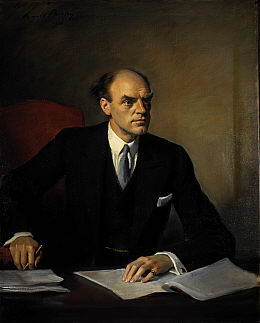
Lord Reith, the founder of the BBC, would certainly not have shared the bemusement that many have felt at the extent of media coverage and public outrage focussed on the Sachsgate scandal.  He would have viscerally appreciated why the national conversation has been dominated by reaction to two boorish entertainers, handsomely paid by the public purse, using the public airwaves to humiliate a young woman in obscene phone calls to her grandfather, a much-loved actor.

The clarity of Reith’s original mission for the BBC to inform, educate and entertain pointed to some degree of moral purpose which still shapes people’s expectations of the organisation.  Since the last renewal of the BBC’s charter at the beginning of 2007, the Reithian mission has given way to six, rather more mushy, “public purposes“.  These could justify almost any activity the BBC chooses to undertake – and, inside the BBC, they do, if we are to judge by Russell Brand’s and Jonathan Ross’s antics and the tardiness of the management’s response.

What is strange is that this is still the case, given everything that has happened in recent years: Hutton, Queengate and the phone-in scandals.  Last week’s events are an object lesson in how an organisation in reputational crisis fails to learn the lessons of its previous mistakes.  Banks, take note.

Read More »