The story of how Heinz’s father, Alfred, fled from Czechoslovakia to Poland through a coalmine, to be followed later by Ethel and Heinz, was featured in a book by Ina Boesch, Grenzfälle von Flucht und Hilfe – fünf Geschichten aus Europa (Borderline cases of escape and help – five stories from Europe). The section comes in a broader chapter on another escapee, Artur Radvanský. Here, with the permission of the author, is a translation by Heinz’s daughter, Susan.
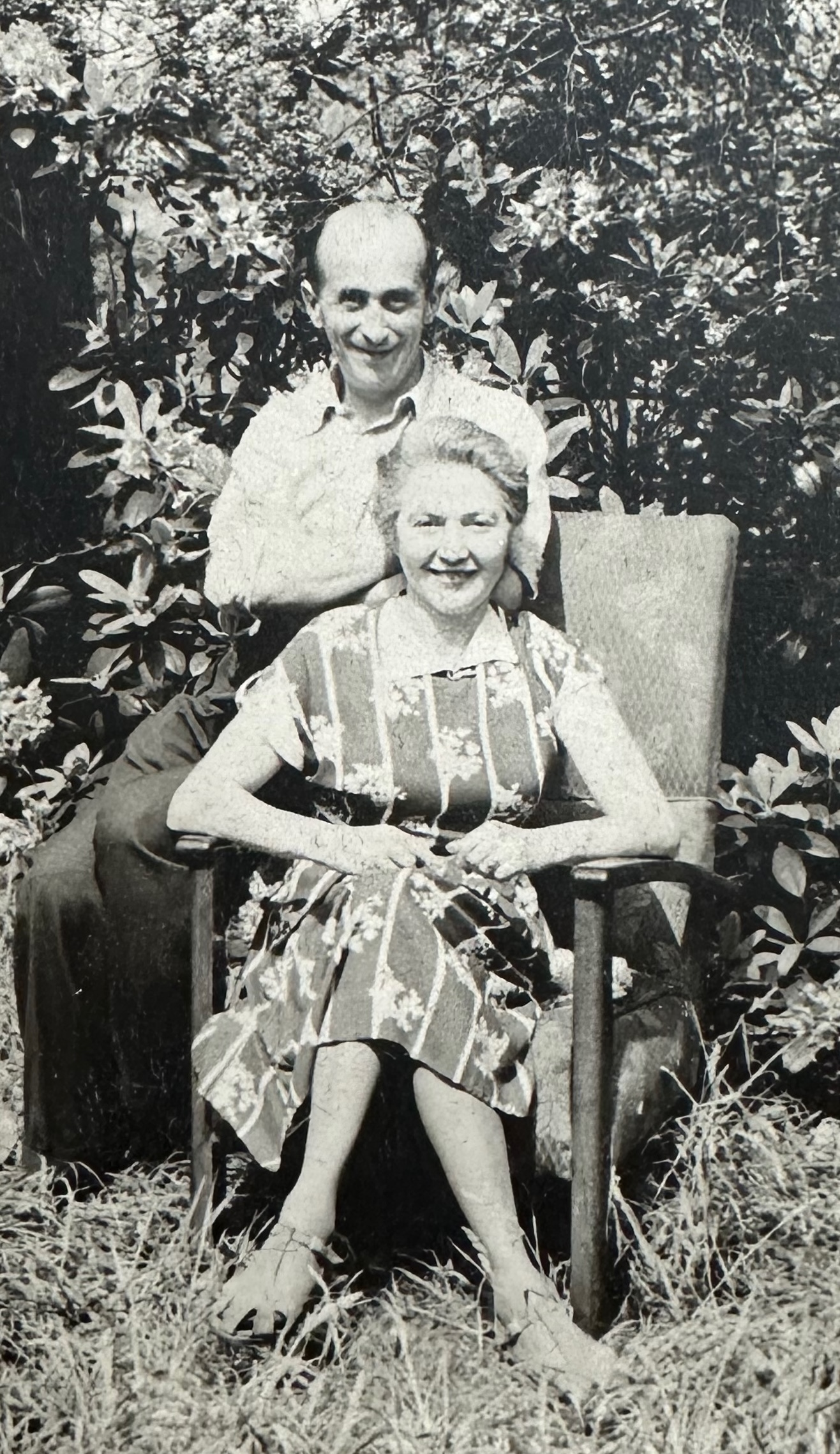
Alfred and Ethel, years later in England
One person who could have proven to the sceptical engineer that there actually was a sophisticated escape system through the coal mines was Alfred Vogel, who died in London. He was one of the countless refugees who fled under the border in 1939. It is quite possible that it was Artur who showed Vogel the way, but it is not guaranteed. In order not to endanger anyone, neither refugees nor escape helpers knew each other’s identities.
Alfred Vogel was a man of the world: the manager of the Ostrava branch of the Viennese “Anglo Elementar Versicherungs-AG” preferred to conduct his business with representatives of heavy industry in the café of the Hotel Imperial in Ostrava, the hotel that Artur only visited on high holidays. Every now and then he would meet his customers at the Hotel Palace, and if he couldn’t see them in one of his favourite restaurants at the best address, he would seek them out in his black Śkoda. In his free hours, he read German classics like Goethe and Schiller, but Heinrich Heine and Thomas Mann were also among his favourite authors. He loved visiting the Deutsches Theater, which was conveniently located, like his favourite cafés, very close to his apartment, and regularly wrote in the Arbeiter-Zeitung about how he liked this or that performance. He had a beautiful and clever wife, Ethel Slatner, and an intelligent little boy named Heinz who went to the German School. Alfred Vogel was German through and through: he spoke German, visited the German Theatre, read German newspapers, but officially he was Czech. That’s what he wanted and declared when the Czechoslovak Republic came into being in 1918. Back when President Masaryk raised the nationality question, he had decided against German nationality and, as an agnostic, he had also decided against the Jewish community, even though both his mother and father were Jews. Vogel wanted to seal his membership in the new state with this identification.
Alfred Vogel was not only a man of the world, but also of action and was involved in the German Social Democratic Workers’ Party in Czechoslovakia (DSAP). When he heard at the end of 1938 that the occupiers had arrested twenty thousand members of the DSAP since their invasion of the Sudetenland, he and his wife made preparations. Ethel Vogel packed her most valuable items in a sailor’s trunk: photo albums, crystal glasses, silver candlesticks, embroidered linens from her dowry, a self-woven tablecloth, clothes and other personal items. She sent the suitcase to an address in England. If circumstances made it necessary, she would have it picked up there or sent on. Instead of playing records with arias by Puccini or Verdi, as the music-loving Ethel did in the evenings, instead of attending theatre performances and writing sharp reviews, as Alfred liked, they took private lessons in English. Little Heinz also studied the vocabulary, and today the tattered Basic English for Czechoslovak Students still sits in the bookshelf of Heinz Vogel in Walton-on-Thames (sic) near London.
When the Nazis occupied Ostrava in March, and the first refugees from Prague sought a way through to the still free Poland, Alfred Vogel went in the opposite direction: he fled to Prague. As an active member of the DSAP, he was on a black list, and he believed he could go into hiding in the anonymous big city rather than in Ostrava, where many, too many, knew him.
In Prague, however, Alfred Vogel quickly realised that he could not stay here and would have to leave the country. In principle, people could only leave the “Protectorate” with a Gestapo pass. These blue notes or the hectographed letter from the military district command were relatively easy to obtain in the first weeks after the invasion – after presenting the necessary visa and connections – and until the end of March Jews were not excluded from this regulation. But Alfred Vogel had neither the visa nor any connections. Alfred Vogel saw no alternative: he had to cross the border illegally – but with whose help?
His party, the DSAP, was dissolving and the party leadership was hastily packing up and going into exile in London. The rival party, the Communist Party, had no longer existed since October 1938, when the party leadership fled to the Soviet Union, but it had taken precautions and set up a well- functioning escape network before the occupation.
Then there were the youth organisations, for example the social democratic National Movement of Working Youth or the Czechoslovak YMCA. They were also active in underground work.
There was the contact address of the exiled actor couple Charlotte Küter and Paul Lewitt, and there were the helpers around the journalist Milena Jesenská, better known as Kafka’s lover, with the speeding automobile driver Joachim Graf von Zedtwitz.
It remains Vogel’s secret whether and from whom he sought help in Prague. In any case, he returned to Ostrava after about two weeks and immediately sought contact with a border guide. It was rumoured that men could be found in the Grün Restaurant and the Café Union who, for a fee, would take people across the border. Vogel agreed with his wife that he would go alone and go to Bielsko-Biala (Bielitz) and would wait with relatives for Ethel and Heinz. The boy should tell his teacher that he would be going away on vacation for an indefinite period of time. One evening Alfred Vogel, wearing nothing but his clothes, left the apartment opposite the German Theatre – and was there again at dawn. What had happened: he had sneaked through the forest at the border with the escape helper and a few other refugees without incident, they had passed the German border guard unnoticed and were already on Polish soil when they met a Polish gendarme. They had no choice but to go back the same way, which was extremely difficult, as they now had to circumvent the German soldiers for the second time, but this time from the other side, from the wrong side, from the side that was particularly well monitored by the Germans. Fortunately, the venture was successful and Alfred Vogel, now a nervous wreck, made it home again. Apparently it wasn’t that easy to cross the border illegally at Ostrava.
In fact, after the Nazi occupation of Czechoslovakia, the Polish police acted ruthlessly against refugees: they arrested many who believed they were finally free and deported them to the “Protectorate”. In the first few weeks there were real manhunts along the border: first the Poles drove back those that were being pursued, then the Germans responded with gunfire so that they fled back to Poland, where they were pushed back again, and so on.
In the meantime, Vogel had found out about other routes, and one evening, it was now mid-April and high time to leave Ostrava, he set off again. This time he returned the same evening, having not even followed the escape helper to the border. When he realised that they were going exactly the same way as last time, he turned on his heel. The situation became more and more threatening for Vogel because the Germans began to systematically search for political enemies and arrest refugees. At the end of April they arrested 1,100, including sixty people who were at serious risk.
In April 1939, Alfred Vogel crossed below the border. Perhaps with the help of Artur from Radvanice, he escaped to Poland through the Ludwig and Hedwig shafts, perhaps it was also the Hruschau tunnel. In any case, a car took him near a pit, from where unknown men led him through the underground system to the other side. There they got into a car that quickly drove them to Těšín. A few days later, Ethel Vogel received the encrypted postcard from Bielsko Biala in Ostrava as agreed.
Similar to Alfred Vogel, many refugees only managed to cross the border safely at Ostrava (or, better, go under the border) only on the second or third attempt. The journey was just as dangerous as the border crossing, as police checkpoints had to be passed before Prague, for example, barriers had to be avoided and anything that could cause a stir had to be avoided. Ethel and Heinz Vogel had to come up with a special way.
On a beautiful spring afternoon in the east of the city, they boarded the narrow-gauge railway that had connected Ostrava with Karviná for almost twenty years. Heinz acted as if they were out for fun, looked curiously out the window and saw the winding towers and chimneys go by. That they actually lived in Poland and had visited their grandmother in Ostrava that afternoon, was the story that the mother had made up and drummed into her boy. The journey to Radvanice didn’t take long, but the tension increased immensely when they left the train. Hearts pounding, they hurried through the forest and passed, without incident, the German border guard, who hardly took any notice of the mother and her child, but trusted that the Polish border guards were doing their job seriously. Ethel Vogel motioned to Heinz to stay behind; she would call him when the time came. The Polish guard, a middle-aged man, wore the uniform of a police officer rather than a soldier, which reassured the mother somewhat. While she talked to the man, very quietly and for a long time, Heinz pretended to have fun with sticks and stones and watched out of the corner of his eye his mother and the strange man.
After a while, it must have been over an hour, he couldn’t stand it anymore and approached the guard, even though his mother had forbidden him to. Is that your boy? When she nodded, everything suddenly happened very quickly. He accepted the story that they had visited their grandmother in Ostrava, but advised her to avoid such trips from now on. Ethel grabbed Heinz by the hand and ran down the street, fleeing, almost flying, to Poland, to Alfred in Bielsko-Biala and its Orthodox Jews with their long beards, curls and black hats. From there they drove to Katowice, which, along with Kraków, was the most important centre for the thousands upon thousands of refugees who had fled from the Protectorate, Slovakia, Austria and Germany.
Many Poles were overwhelmed by the onslaught of ten thousand refugees, mostly Jews, who had fled from the Czechoslovak Republic to the neighbouring country – and the public reacted with anti-Semitic campaigns. That’s why the Vogel family, like most refugees, stuck to one of the countless league refugee organisations in Kraków that cared about their homeland, took care of the people who had been lost and tried to organise their departure via Gdynia in the Bay of Gdańsk. They finally received the longed-for tickets from Alfred’s DSAP party for the journey to freedom on the MS Sobiesky. On 20th June they set foot on English soil in Dover.
In June 1939, synagogues burned in Ostrava and the surrounding area. The signal could be seen from far away, the message unmistakable. Artur and his parents watched the events with great concern, but they wanted to stay instead of fleeing – not because they had illusions about the Nazis, but because they trusted their non- Jewish neighbours and acquaintances. Why should Trudi Hajek, with whom Artur occasionally went dancing, turn against the family of the leather goods dealer Tüberger? Why should the shoemaker Gustl, who bought leather from Marek, turn away from his friend? After all, they were comrades in the war and bonded through three years of service at the front. The Tübergers were also confident that many non-Jews reacted with compassion and solidarity when the National Socialists began to introduce their anti-Jewish regulations and laws. A considerable number of non-Jews were of the opinion that anyone who enriched themselves from Jewish property in the course of Arianisation was a traitor to the people.
That’s why Artur only gradually realised what the anti-Jewish laws meant. When it was decreed in June that Jews could no longer use their accounts, the son of poor parents didn’t care much. However, when he was no longer allowed to work in July, he began to seriously think about his future. He could have tried to emigrate legally in Prague, because at that time the National Socialists began to force the emigration of the Jewish population: at the end of July, Adolf Eichmann and his men founded the Central Office for Jewish Emigration in Prague and placed it under the Control by the Gestapo. But which Jew would want to meet the Gestapo?
From August onwards he was no longer allowed to go to restaurants, neither the Café Grün nor the Café Union, which was heavily frequented by Juden, nor to go to museums, theatres, concert halls, nor to cinemas to watch films with Paul Robeson in the lead role, nor to swimming pools and hospitals would henceforth remain closed to him. It became clear to him that these measures were only the first step towards the systematic exclusion of Jews from society. What he was also told about the persecution of Jews from Germany and Austria ultimately confirmed his decision to leave the “Protectorate” illegally. He had made contact with a very influential and wealthy Czech in the region: Jan Bat’a from the Bata shoe empire. As early as 1938, he had brought Jewish employees of the global company to safety by distributing them to branches around the world and continued to help those in danger of life and limb wherever he could.
From: Ina Boesch, Grenzfälle von Flucht und Hilfe – fünf Geschichten aus Europa, 2008, Zurich, Limmat Verlag.
 Vogel Vault