Heinz spent his final years in Canterbury, not far from Margate where he had first settled on arriving in Britain in 1939. He died peacefully, aged 95, a father, grandfather and great-grandfather. This is how we remembered him at his funeral.
Heinz Vogel, 18 February 1928 – 18 November 2023
By Martin, 30 November 2023
Heinz’s story is that of a happy childhood home, lost too early. And of the multiple ways he found home and rebuilt family in his adopted country over a long and resilient life.
Heinz was born in 1928 – the only child of Ethel and Alfred.
Home, until he was 11, was Ostrava – a cosmopolitan and prosperous city in Czechoslovakia. While his immediate family was small, he was part of a large extended family, the Slatners. His mother was one of 13 children and Heinz was enmeshed in the lives of his cousins. We have a picture of him with five cousins and his grandmother, Emilie. She and three of the cousins – Kurt, Pauli and Edith – were murdered by the Nazis. Heinz, Vera and Eve survived – joined later by Thomas, Eve’s brother, who was born after the war.
When the Germans invaded, in 1939, my grandad faced double jeopardy as he was a known socialist as well as being Jewish. Perhaps his political acumen is what saved his family. He wasted no time in getting them out of occupied Czechoslovakia.
On his last day at school, Heinz told his teacher he wouldn’t be there the next day as he was going on holiday. His teacher said that he knew why he was leaving – and that his family was making the right decision.
***
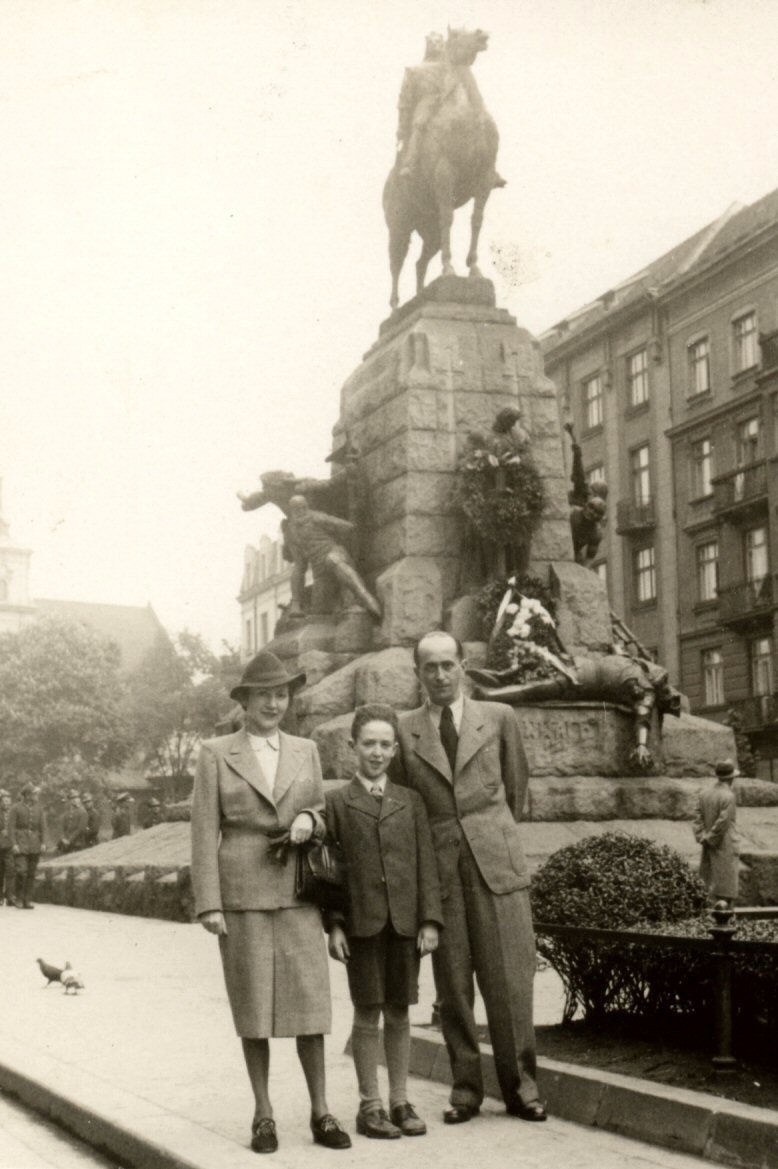
On the back of your service booklet, there’s a picture of Heinz and his parents in Krakow, where they waited out a few months. It looks like a snapshot of tourists on a day out. Not refugees, who’d left everything and knew not what the future held.
They made their way to England and stayed initially at a camp in Birchington up the road from here. So Heinz’s life in Britain came full circle when he returned to Kent in the last years of his life.
Eventually, they settled in Marple near Manchester.
***
He was always a man of singular interests. It was his enthusiasm for airplanes that led him, after he left school, into the aircraft industry.
He long considered himself fortunate not just to have worked in a field that he loved, but to have been in at the dawn of an emerging industry. He saw the heyday of British aviation. Heinz trained as an aerodynamicist, a profession he was able to maintain until his retirement some 40 years later. Yet this still accounted for less than half his life.
He worked on the Vulcan, a great delta-winged bomber. And he was the lead designer on the 1-11. In its time, this was the most commercially successful airliner in Europe. It’s characteristic of Heinz’s modesty that I learned this only in the days since his death.
***
Early in his career, Heinz met Peter Sara, who became his lifelong friend and brother-in-law. Heinz was best man at Peter’s wedding to Jose. This is where he met Margaret, Jose’s younger sister and my mother. She was the maid of honour. Heinz made some flirtatious comment to Margaret in his best man’s speech. They were soon in a relationship.
After they were married, Heinz’s career took them to the Isle of Wight, Luton – where Susan, Louise and I were born – and eventually Weybridge, where they lived for 40 years.
Heinz loved Weybridge. We lived on a new-build estate formed around a cluster of trees – that we called the spinney – where we all played as children. It wasn’t many years before this became the home he had lived in for the longest time. My parents’ life was focussed on the close and long-lasting friendships they formed with other young families in the street. And the rumbustious Christmases we had with a houseful of cousins.
Heinz spent happy hours tinkering with his car at the weekends. He liked playing classical music on his stereo, perhaps while spending the evening helping us with our homework or arranging the many photos he took of letterboxes. As I said, a man of singular interests.
***
We were a mixed-heritage family – brought up Catholic but also proudly Jewish. We celebrated Jewish festivals with my grandparents.
My father was also conscious of his Czech identity. Czech composers featured prominently in the soundtrack of his life.
He maintained his childhood interest in Czech stamps.
There is a poignant postcard sent to him by his Aunt Bertl, with a grim postmark commemorating the German invasion. Bertl was also murdered by the Nazis. Somehow my father managed to hold onto the postcard as he left Czechoslovakia and kept it his whole life.
***
Which brings us to the remarkable years of his retirement.
He wanted to draw his pension for as long as he had earned a salary. This goal he exceeded despite having never knowingly pursued a healthy lifestyle.
What kept him active and his mind sharp was what can only be described as a life of quiet service.
He helped colleagues made redundant from British Aerospace establish a printing business, Brooklands Press.
He became involved with the Thames Valley Talking Newspaper. Before long, my dad had instigated an award-winning monthly audio magazine of local news and features. This he produced from his crowded little office at home. He became the chairman of the charity and it survives today as Elmbridge, Runnymede and Spelthorne Talking Newspaper.
His audio production skills proved useful when he received an email requesting his help with a project getting under way at Kingston Synagogue.
***
Heinz had never really spoken much about the flight from Czechoslovakia and the loss of much of his extended family.
Two things changed this.
The opening up of Czechoslovakia after the Velvet Revolution in 1989 enabled him to go back for the first time in 50 years, and he began researching his family’s history.
And his grand-daughter, Kerrie, asked him directly for his memories when she was studying the Holocaust in a school project, aged 11, the same age Heinz had been when he left Ostrava.
Heinz wrote Kerrie an evocative letter, recalling events from the perspective of his 11-year-old self. The letter was read out in class and subsequently did the rounds of other siblings and cousins around the country, as they reached the same part of the curriculum.
Heinz wrote up more expansive memoirs, which I posted on the web for the family. They were found by David Lawson who was researching the story behind Kingston Synagogue’s Torah scroll, which had come from Ostrava.
As it happens, living in Weybridge, Heinz was just down the road from Kingston. He was the first of the Ostravaks David had found. Soon the pair were teaming up to record oral history interviews with other survivors.
The Kingston Ostrava Circle eventually reached a few hundred people who were either escapees or their descendants. In a sense, it reconstituted the Ostrava Jewish community as a virtual community, with annual gatherings in person. In David’s book on the Ostrava Jews, there’s a chapter on the Vogel and Slatner families.
In his quiet way, Heinz became a tireless educator of the lessons of the Holocaust. He told his story to diverse audiences and always found a hook to make it relevant to those he was addressing. At my local primary school, where about 50 languages are spoken, he linked it to refugee week. For his friends at the Czech Philatelic Society, he used the postmarked card from Aunt Bertl.
***
All this drew slowly to a close as Heinz turned his focus to caring for my mother as dementia took hold.
This he did without complaint for a good decade.
Having never been much of a cook, he put meals on the table every night. True to his engineering training, if there was a dish he wanted to try, he would research different recipes on the internet and then compose his own definitive version by means of a spreadsheet.
When it was time to do the ironing, he’d do this at night, after Margaret was asleep, so as not to confront her with her declining capabilities.
He was devastated when she died nearly 12 years ago, shortly after they’d moved to Canterbury.
He found new friends at the Synagogue and in the Tuesday conversation group at Talk Time.
Louise – with Paul’s great support – took unstinting care of my father through this time … in the last couple of years, with the additional help of his brilliant carers and his friend, Piroshka.
As a family, we were able to honour his wish to live out his final years at home, and Louise was by his side at the end.
***
Aged 95 when he died, Heinz lived long enough to see the little family that had arrived in Britain in 1939 grow by three further generations.
In the final months of his life, he enjoyed the company and love of his grandchildren and great-grandchildren. In my last conversation with him, I was able to tell him that another great-grandchild was on the way.
Heinz’s memory will be carried by all of us. If his great-grandchildren inherit his longevity, he’ll be remembered nearly two centuries after he was born.
May he rest in peace.
And may his memory be a blessing.
 Vogel Vault