Robert Conquest’s claim that “every organisation behaves as if it is run by secret agents of its opponents” seems outlandish at first glance. But if you allow yourself to reject the fake news, bullshit (non)sense-making that most organisations try to impose on us, it’s hard not to keep stumbling into the truth of Conquest’s law.
The simplest way to explain the behaviour of any bureaucratic organisation is to assume that it is controlled by a cabal of its enemies.
The aphorism strikes me as so profound and relevant that I have often tried to verify its attribution. Conquest was a renowned historian of the Soviet Union, so his opinions on the politics of organisations carry considerable credibility.
As previously discussed on this blog, we favour conversational approaches to eliciting the development of leaders. When we’re working with groups who have an ambitious purpose but face a variety of complex options, we look for ways to break free of linear and binary thinking and instead synthesise diverse perpectives.
One approach on which we draw for inspiration is open space. It seems a pre-requisite for these conversational processes that they have mystifying names. This is no exception and its formal nomenclature – given by its originator, Harrison Owen – is Open Space Technology. Beneath the name lies gold. Put simply, it is a method for a group of people to self-organise multiple, simultaneous conversations around a related theme. It is energising for the participants and, in our experience, produces more interesting outcomes than laboured discussions led by facilitators.
If there’s one signature intervention that characterises how we work at Vogel Wakefield, it is the diagnostic enquiry into what’s going on in an organisation. This draws on skills developed over the course of our careers in journalism, strategy and coaching – and, in my case, my epistemological formation as a sociologist. Put simply, it entails getting lots of people to talk to us about their working lives. And trying to understand what it is they need to talk about together that they’re not discussing. Many of our engagements begin this way – particularly when a team or organisation is stuck in some way, which is usually when they turn to consultants.
Katharine Graham and Ben Bradlee celebrate the court’s decision in 1971 to allow publication of the Pentagon Papers.
Steven Spielberg’s film The Post combines three themes close to my heart: leadership, journalism and power – with an interesting gender dimension overlaying all three.
The film portrays the days in 1971 when the Washington Post faced a dilemma whether to publish leaked material, the Pentagon Papers, showing how successive American presidents had deceived the public about the country’s purpose and prospects in Vietnam. The scoop already belonged to the New York Times. But an opportunity to catch up arose for the Post when Nixon’s government obtained an injunction against the Times, and the Post obtained the material independently.
There have been criticisms that it is perverse of the film-makers to focus on the role of the Post in the the Pentagon Papers affair, when the Times was the bigger player and took the earlier risk. However, that is to misconstrue the drama in which the Pentagon Papers affair is merely the MacGuffin on which hangs a tale of press freedom and gender politics. It is precisely because the Post was the lesser player that it merits attention. It’s the story of how a faltering business, guided by a woman in a male-dominated world, steps into the big league and transforms itself into a pillar of democracy. The whole episode serves as a dress rehearsal for Watergate, when the Post made the running in holding Nixon to account and ultimately brought down his presidency.
If I’m working with a group that is highly committed to improving the quality of relationship between them, I might reach for Insight Dialogue.
This is actually a meditation practice developed by Gregory Kramer, a meditation that is conducted in relationship with someone else. Its essence is that it interrupts the normal routine of conversation with deliberate pauses and reflections, so that we might connect with the perception that we hold that might otherwise lie just beneath conscious awareness.
One of the methodolgies we use to change the habits of conversation in organisations is nonviolent communication (NVC). This is a clunky name for a practice, developed by Marshal Rosenberg. It is deceptively simple but also profound in the insights it generates about what’s going on when people talk to each other.
Marshal Rosenberg’s key insight is that often in communication, people are seeking – consciously or unconsciously – to satisfy needs. It’s the frustration of these needs that can cause relationships to become mired in conflict. The route to understanding needs is to notice the feelings that are at play in a situation. So Marshal Rosenberg proposed a four-fold grammar for communicating in a way that could help people bring empathic attention to these factors.
A lot of our work in organisations focusses on getting people to show up differently in conversations. This is because it’s through conversations that organisations exist. People often think of organisations as structures which have a solidity beyond the people who comprise them. There’s some truth in this construct. The BBC existed long before I joined it and seems to be managing to survive quite adequately even though it’s a decade since I left.
But it’s also true that organisations are enacted into being by their members. The day-to-day interactions people have with each other in organisations are much more material to how things get done than the structures, strategies, documents and plans that people imagine to be their work.
Some years ago, I attended a meeting on whether executive coaching could help make society better. I mentioned a Marxist critique of the crisis in capitalism that I had recently read. Before I even managed to share any insights that I’d found relevant, one of my associates brushed aside my contribution – asserting something along the lines that we didn’t want the Stasi in the UK (a sentiment with which I naturally concur). He seemed to want to restrict the conversation to the role of business in promoting environmental sustainability. The episode defined for me a sensibility in working life that holds to faux-apoliticism as a badge of professionalism. In this view of the world, there’s a safe agenda of social change, which allows a degree of corporate virtue signalling around our shared interest in planetary survival, but forbids the potentially more divisive discussion of wealth and power and the role of organisations in sustaining them.
This distinction is increasingly hard to sustain. The backlash against a capitalism that consigns whole communities to the backwaters is recognised as a factor in both Brexit and the election of Donald Trump. This year, the Grenfell Tower fire gave us a grotesque demonstration of where apolitical collusion with the apparently natural workings of the economy can lead. Not just the circumstances that led to the fire but the local authority’s inability to respond to the disaster revealed a hollowed out state, in which an over-financialised approach to management overwhelms the ability of organisations to meet basic human needs.
Politics of organisation: hopefully, not like this, this time round.
Earlier this year, I attended a talk at the RSA by Frederic Laloux, author of Reinventing Organizations. Laloux was every bit as inspiring as I had hoped after reading his book. But what has stayed with me also was a throwaway comment by Matthew Taylor, chairman of the RSA and former advisor to Tony Blair when he was Prime Minister. Reflecting on the paucity of organisational life, Matthew observed that we need a politics of organisation. Yes, I thought, this is exactly what we need and, at last, people are beginning to get it.
The politics of organisation was, of course, one of many absences in the General Election campaign. One of the successes of three decades of neo-liberalism is that what happens inside organisations has been ruled out of court for politicians. But at the same time, organisations – particularly private corporations – have become increasingly central to how our society is, well, organised. Most of us work in large organisations to earn our living and, with the hollowing out of the state, depend on them for the delivery of our public services. And what is left of life is increasingly mediated by the likes of banks that are too big to fail, food retailers whose chains extend from the convenience shop to the out-of-town megastore, and global internet businesses such as Google, Amazon and Facebook. How we experience them as employees and consumers and how they impact on society in general are among the most significant influences on our lives.
Simon Western has ruined my eager anticipation of the Apple Watch (launching late next month, pre-orders from 10th April). In a profound and reflective piece, he discusses how the Watch (as opposed to the humble watch) represents the latest and most decisive step towards the creation of a neurotic age.
Key to this argument is the insight that technology is not simply an appendage to human life but changes what it is to be human. As Simon Western says, we are so affectively attached to the brands and products of the technology companies that they become a part of our emotional, physical and cognitive being. Apple is foremost in facilitating this attachment – with its celebrated competence in combining the disciplines of arts, humanities, science and technology in the service of the development of products to die for. But it is far from alone, as exemplified by the signal obssessions of our day: monitoring of Facebook, Twitter, Instagram or email; the pre-eminence of collecting selfies above experiencing life; or the quantifying of one’s lifestyle.
The book deconstructs the managerialist consensus that construes organisations as being somehow apart from society, and amenable to direction in whatever way managers consider to be “efficient”. Efficiency, in this worldview, turns out to be the right of senior managers/shareholders to optimise the running of the organisation in their own interest. It does not lack an ethical claim. Taylorism, for example, freed factory workers from the tyranny of the gang leader and offered a fair day’s pay for a fair day’s work. But it led to a perverted extreme by which, to quote one of Grey’s contemporary examples, it can seem rational and legitimate to require machine operators to urinate on the spot in their clothes on the grounds that allowing lavatory breaks is too costly.
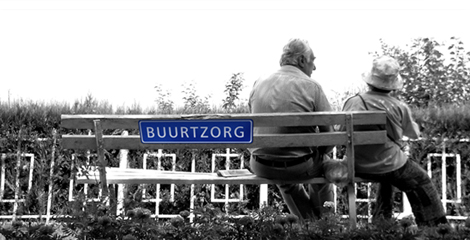
Buurtzorg, a higher level of consciousness in organisational form
Book review: Reinventing Organizations by Frederic Laloux.
In the years since the financial crisis, we’ve honed a conviction here at Vogel Wakefield that the way most businesses and organisations are run is bust. Public distrust has been engendered not just by the financial crash but scandals in sectors as diverse as the health service, the media, supermarkets, the police and Parliament. Such is the depth of distrust that we envisage society eventually breaking decisively with the economic settlement of the past three decades. What the shape of the new consensus will be, who can tell? But the future surely entails profound changes for the way organisations are run. The public wants businesses to exercise greater stewardship of community assets and to operate in a more socially-oriented way.
If this vision sounds nebulous and, frankly, utopian, the exciting thing about Frederic Laloux’s book, Reinventing Organizations, is the detailed portrayal it presents of successful companies that are making real today the model of tomorrow. His view of the forces of change is broader than ours. Where we envisage this as a paradigm shift in contemporary capitalism, akin to that from social democracy to neo-liberalism thirty years ago, Laloux sees a fundamental shift in human development, the kind of shift that occurs as human consciousness develops. In this, he draws on the work of Piaget, Robert Kegan and, especially, Ken Wilber.
Last night, I attended a stirring call on the coaching profession to wake up and recast its responsibilities in relation to a world that is messed up and in crisis. The call was made by Aboodi Shabi, who one might reasonably describe as a leader of the coaching profession in the UK. Courtesy of a platform with the London Coaching Group, he extemporised on themes I have advocated myself, most recently in my presentation to APECS. But Aboodi made the case with a passion and bluntness that challenged me to stand up for this agenda with much greater clarity. A theme of the evening was how coaching could “come out” as a profession that engages with society’s problems. Aboodi’s message resonated with a good proportion of his audience, although it also provoked fear and dismissal among a vociferous minority.
“Corporations as a force for good” was the optimistic title of a talk given by the London Business School academic, Lynda Gratton, at the Royal Society of Arts today. Her thesis was more a paean to than a critique of corporations. On the evidence she presented, I found her optimism a little premature. Corporations can be great conduits for the creativity and fulfilment of employees and the fulfilment of societal needs at massive scale. But they are vessels for trapping employees in alienating conditions, exploiting their consumers and society at large and they often ask too few questions about their supply chains. “Could do better” would be a more appropriate assessment of the current contribution of corporations.
Whistelblowers past and present: George Picquart, French Army, and Julie Bailey, Cure the NHS
Robert Harris’s novel An Officer and a Spy is not only a cracking read but a psychological study in the gathering courage of a whistleblower in an organisation gone to bad.
It tells the story of the Dreyfus affair – the wrongful conviction and incarceration for spying of a Jewish officer in the French army at the end of the 19th Century. It is told through the eyes of Georges Picquart, a spy chief who is both a party to the downfall of Dreyfus and a prime mover in the uncovering of Dreyfus’s framing by the military establishment.
Much of the power of the narrative derives from the fact that Picquart is a reluctant whistleblower. The youngest colonel in the army, he has a great career ahead of him. Moreover, he shares the casual anti-semitism of his age and has no great sympathy for Dreyfus. Nonetheless, when he discovers evidence that implicates a different officer, Esterhazy, in the spying for which Dreyfus was blamed, he cannot ignore the injustice and assumes his senior officers will think likewise.
The unharmonious sound of an establishment closing ranks could be heard last week when an NHS hospital attempted to discredit the account by the MP, Anne Clwyd, of the death of her husband while in its care. While conceding that Ms Clwyd’s husband, Owen Roberts, died of hospital-acquired pneumonia, the University Hospital of Wales said it had no evidence to support Ms Clwyd’s assertion that Mr Roberts had died “like a battery hen.”
Cardiff and Vale University Health Board released a summary of an independent inquiry into Ms Clwyd’s allegations but declined to release the full report. So it’s impossible to assess what evidence it evaluated before reaching a view that Mr Roberts didn’t die like a battery hen.





 Simon Western has ruined my eager anticipation of the Apple Watch (launching late next month,


 Vogel Vault