Universities and public value

By Martin Vogel

test card
BBC Test Card image.

Higher education’s status as a not-for-profit public service operating in a globally competitive market is unusual. There are not many comparable institutions – and this can make HE’s travails, as it contemplates regulatory change, seem like a lonely struggle. But HE is not alone. An analogous institution is the BBC. There are affinities in terms of cultural role, independence and longevity. But the most striking is the exposure to competition while pursuing public purposes. This creates a tendency towards managerialism and instrumentalism that can be counter-productive. To keep this tendency in check, and retain public support, the BBC turned to the concept of public value. Universities are now exploring the same avenue, as they try to regain public connection, revealed by the Brexit vote to be threadbare. Read More »

Higher education round-up

art and tech

Here’s a round-up of our series on higher education. People were asking us, “What’s it like to work with you?” So we wrote this series to provide an answer. In the posts below, we explore what we’ve learned from working in the sector and what our counter-consultancy approach has to offer universities and those who work in them:

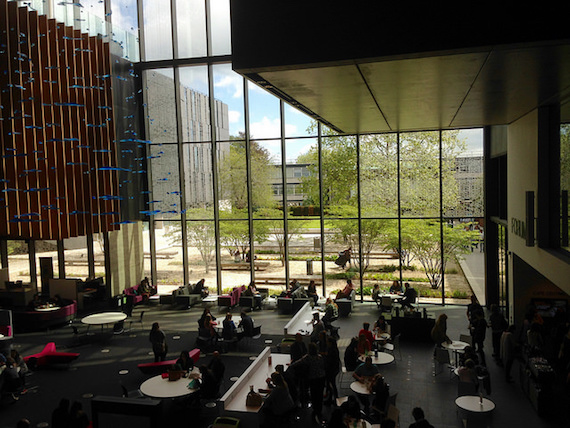
Image courtesy University of Salford.

Reconnecting universities to their public purposes

By Martin Vogel

obu

This is the final post in our series looking at how our counter-consultancy approach meets the needs of higher education institutions. Here we explore how interdisciplinarity and external collaboration can revitalise the public value of universities.

Interdisciplinarity and external partnerships provide a foundation for universities to renew their public value. This is because they grow out of the genuine and distinct strengths of a particular institution and point to how it can make a unique contribution to addressing society’s challenges. But this contribution can be realised only if there is clarity about the institution’s public purposes: the generic ones it shares with other higher education establishments and the distinct one that arise out of its own particular circumstances.

Read More »

The emergent route to fostering interdisciplinary collaboration in higher education

By Martin Vogel

networking

This is the third in our series looking at how our counter-consultancy approach meets the needs of higher education institutions. Here we explore the complex nature of university cultures and how we use conversation and reflection to mobilise distributed leadership.

Interdisciplinarity can address a university’s need for funds and a distinctive marketing proposition but also the individual academic’s need for compelling research opportunities. If each university has unique research strengths, these can be synthesised into interdisciplinary ventures which pursue approaches to research excellence that can’t be replicated easily elsewhere. This creates compelling reasons for funds, students and academics to gravitate to particular institutions. It counters a view of higher education as a largely undifferentiated, instrumental business with one which construes it as comprising diverse institutions each with intrinsic value and distinctive contributions to make to the world’s knowledge.

Read More »

Interdisciplinarity and external partnerships: components of revenue generation and public value in higher education

By Martin Vogel

library

Over recent years, we have developed a focus on supporting academics and managers in universities who are trying to foster greater interdisciplinary working and greater engagement with external partners. This series of blog posts reviews our learning in this area and explores how our counter-consultancy approach is especially suited to resolving challenges that higher education institutions encounter in pursuing interdisciplinary objectives.

Interdisciplinarity and external partnerships are distinct but closely related areas for universities. While disciplines represent communities of practice that transcend the boundaries of any one university, the idea of disciplines also serves as an institutional heuristic that facilitates internal ways of organising. But in their pursuit of research outcomes that deliver tangible value to society, universities are finding that questions that range across disciplinary distinctions are increasingly salient. This is largely driven by the complexity and pace of change of the modern world. Governments and other funders of research are searching for solutions to big global challenges that are best approached through joined-up interdisciplinary enquiries. Funding is increasingly focussed around themes such as demographic change and wellbeing, food security or climate change. External partners too, caught up in this complexity, are bringing research questions that range across disciplinary distinctions.

Read More »

Trust is not a message, it’s an outcome: the lesson for leaders from a defector from PR

By Martin Vogel

Trust
Trust is an outcome.

In Trust Me, PR is Dead, Robert Phillips has ostensibly written a book on the bankruptcy of public relations. It’s more interesting, though, as an insider’s guide to the bankruptcy of much corporate leadership – and, more importantly, a cogent call to arms for leadership that can inspire trust. I say “call to arms” since this is not a manual for leaders of the kind that sells at airport bookstands. It’s more a citizens’ manifesto – stirring us from neoliberal slumber so that we may realise our distributed leadership and haul conventional corporate leaders into the service of a fairer form of capitalism. It’s a foretaste of how leadership must surely evolve to meet the challenges of our more transparent, networked society and the expectations of the Millennial generation who will soon inherit the workforce.

Read More »

Sustaining public service broadcasting worthy of the name

By Martin Vogel

reithFollowing my post earlier this week on the difficulties at the BBC, I have been chastised by a good friend and former colleague for being too harsh on the Corporation. The specific criticism was that my piece offered no evidence that I valued anything in the BBC.

On reflection, the complaint seems justified. As both a consumer and a former employee, I’m happy to record that I find much to cherish in the BBC’s output and modus operandi. Given how besieged staff inside the organisation feel, perhaps I erred in assuming that this was taken as read.  It is because I respect the nobility to which BBC journalism aspires that I am perplexed by its falling from grace.

However, all organisations need critical friends who are prepared to speak difficult truths. What people value in the BBC – or, more precisely, in its purpose of public service broadcasting – will be at risk if it remains sanguine about the existential threat it faces. The purpose of public service broadcasting is not served by trying to equate it with everything the BBC does. Nor by insisting that the activities we value in the BBC need to be undertaken by a single monolithic broadcaster.

Read More »

The BBC: judgment suspended

By Martin Vogel

New Broadcasting House, London

As a former BBC hand, I wonder whether people inside the BBC appreciate just how out of control it looks to the outside world? The failures at Newsnight over its mistaken (semi-) identification of Lord McAlpine as a paedophile have revealed what should have been unimaginable lapses in basic journalistic protocol. The director-general’s subsequent resignation with a £450,000 pay-off looked like the BBC Trust had lost the plot. And BBC News is running out of seasoned hands as executives keep falling in the line of fire. But the message from the BBC is “steady as she goes.”

Read More »

The LSE and Gaddafi

By Martin Vogel

Colonel Gaddafi, erstwhile friend of the LSE

Sir Howard Davies, Director of the LSE, defending the LSE’s acceptance of a £1.5 million donation from Saif Gaddafi makes for interesting listening.

Today, it is uncontroversial to point out that a leading university of the social sciences might be compromised by accepting money from the family of a pernicious dictator. Saif Gaddafi’s bellicose statement last week in support of his father’s regime in Libya has seen to that. But when the decision was taken – only seven weeks ago – the calculation must have looked very different.

Read More »

Health care and the dignity of humans

By Martin Vogel

hands_002-thumb1

The Health Service Ombudsman’s report on how the NHS is failing to treat elderly people with care, dignity and respect begs the question of how a service whose raison d’être is to look after people can so dehumanise them.

The report highlights the cases of ten people who suffered grievous neglect. Many of them were fit, active and healthy before treatment but all but one died during or soon after the events they experienced in the care of the NHS, and in circumstances which caused distress and anger to the patients and their families.

Read More »

Mind the gap: how to focus on your purpose in the arts

By Martin Vogel

gallery
Empty gallery.

A theatre won funding to improve its engagement with disadvantaged groups. It approached the challenge as the chance to spread the word about its work. But it discovered that to get the target groups through the doors, the work would need to change. What the theatre was doing from day to day turned out to be irrelevant to a section of the community it was meant to serve. This is an example of the gap that can occur between the way an organisation behaves compared to its avowed mission, one that provides the sense of purpose from a shared understanding among everyone who works in a company.

Read More »

Another crisis in public service broadcasting

By Martin Vogel

Another crisis in public service broadcasting
Lord Reith.

Goodness gracious, what would Reith have thought?

Lord Reith, the founder of the BBC, would certainly not have shared the bemusement that many have felt at the extent of media coverage and public outrage focussed on the Sachsgate scandal.  He would have viscerally appreciated why the national conversation has been dominated by reaction to two boorish entertainers, handsomely paid by the public purse, using the public airwaves to humiliate a young woman in obscene phone calls to her grandfather, a much-loved actor.

The clarity of Reith’s original mission for the BBC to inform, educate and entertain pointed to some degree of moral purpose which still shapes people’s expectations of the organisation.  Since the last renewal of the BBC’s charter at the beginning of 2007, the Reithian mission has given way to six, rather more mushy, “public purposes“.  These could justify almost any activity the BBC chooses to undertake – and, inside the BBC, they do, if we are to judge by Russell Brand’s and Jonathan Ross’s antics and the tardiness of the management’s response.

What is strange is that this is still the case, given everything that has happened in recent years: Hutton, Queengate and the phone-in scandals.  Last week’s events are an object lesson in how an organisation in reputational crisis fails to learn the lessons of its previous mistakes.  Banks, take note.

Read More »

Libraries are needed now more than ever

By Martin Vogel

West End Lane, NW6 – home to a dozen cafes and a library

Camden Council in north London, where I live, is considering changing the ethos of its libraries – to allow people to bring in food and drink and use their mobile phones.  The intention is to make libraries more appealing to young people.

As both a library user and the parent of a young person, this strikes me as an unfortunate and misguided idea.  Libraries are one of the few public spaces in the inner city to which people can turn for quiet.  Swiss Cottage, in the borough, hosts one of the best public libraries in the capital.  Young people constitute a significant proportion of the users.  They go there to find space where they can give unashamed attention to learning.  It’s a place of thought, study and contemplation.  It is wholly unsuited to be a stage for mobile phone conversations or snacking.  Urban life provides an abundance of venues for these activities.  The library offers an alternative realm.

Read More »